-
Corn seed trait: Monsanto Genuity SmartStax RIB Complete
Monsanto’s much-awaited refuge-in-a-bag (RIB) technology was approved last spring and offered in limited quantities for production. This year, a full-scale launch is under way. Called Genuity SmartStax RIB Complete, the product is a blend of 95% SmartStax seed and 5% non-insect-traited corn seed. It offers above- and belowground insect protection in a single-bag refuge product. Growers using this new product will not need to plant a separate refuge for above- or belowground pests in the Corn Belt.
-
Corn seed trait: Dow AgroSciences Refuge Advanced
Dow AgroSciences’ refuge-in-a-bag product called Refuge Advanced is powered by SmartStax. The product was planted on a limited number of acres last spring after it received EPA approval in early April. Refuge Advanced is a blend of 95% SmartStax corn seed and 5% refuge (non-Bt) seed that farmers can plant across an entire field. This means farmers who plant Refuge Advanced products no longer need to plant a separate, structured refuge for above- or belowground pests in the Corn Belt. Refuge Advanced will be fully distributed this year through Dow AgroSciences seed brands.
-
Soybean seed trait: Pioneer Hi-Bred Plenish
Pioneer Hi-Bred’s new high-oleic-oil soybeans called Plenish are expected to hit the market in 2012, following regulatory approvals. Plenish will be Pioneer’s first biotech soybean product to offer benefits to farmers, the food industry and consumers. The soybeans contain more than 75% oleic content, the highest of any soy product to provide high heat stability for frying. The new soybean also has 20% less saturated fat, making it healthier for consumers.
-
Alternative energy: Enogen corn from Syngenta
Syngenta received approval for commercialization of its new Enogen hybrids for ethanol production. The new line is bioengineered to more efficiently convert corn into ethanol. The Enogen grain itself produces the alpha amylase enzyme. As a result, ethanol producers using Enogen grain do not need to add a liquid enzyme to transform starches to sugars, which lowers production costs. Syngenta estimates the savings for a plant producing 100 million gallons of ethanol is $10 million. Plus, less water, electricity and natural gas are used for the ethanol process. Syngenta is carefully controlling the distribution of the new hybrids to ensure the grain is sold only to ethanol plants.
-
Crop protection: Dow AgroSciences Enlist Weed Control System
Dow AgroSciences is rolling out an ambitious crop protection program called Enlist Weed Control System to help handle increasing weed-resistance troubles. Enlist includes a new formulation herbicide called Enlist Duo that includes 2,4-D and glyphosate herbicides. Enlist Duo will be used over the top of a new 2,4-D-tolerant seed trait that is coupled with glyphosate tolerance. This multipronged approach is designed to address weed-resistance problems in the field. Visit www.enlist.com.
-
Fungicide: Xemium BASF
A unique name and a unique mobility feature piqued interest in BASF’s next-generation fungicide called Xemium. The new active ingredient contained in Xemium will travel systemically and will completely cover a leaf. As a result, the product offers strong preventive and curative properties against a wide spectrum of fungi. Xemium is derived from the carboxamide class of chemistry. BASF says the carboxamide molecule has been improved so Xemium performs better than previous products. The new fungicide should be on the market this year pending regulatory approval.
-
Autonomous vehicles: Machine Sync from John Deere
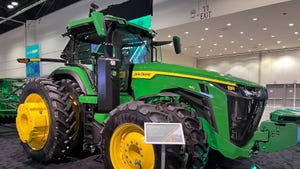
The automated unloading system called Machine Sync introduced by John Deere last summer is the first official product to come to the market with autonomous technology. While other companies have shown experimental robotic equipment, Deere’s will be the first coming to the market in 2012. Machine Sync basically allows a combine to take control of the tractor and grain cart for automated grain unloading. The system uses a wireless communications field to control up to 10 vehicles. When a grain tank is almost full, the combine operator sends a ready-to-unload request to the tractors in the network. The next available tractor enters the zone and the combine takes control of it.
-
Precision navigation: Trimble RTX
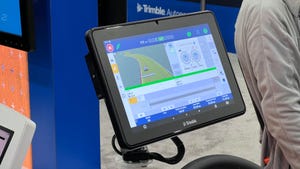
The new CenterPoint RTX service from Trimble is a big step toward more accurate GPS service. Trimble announced the new high-accuracy GPS service option after the company purchased the OmniStar correction service last year. RTX uses both GPS and GLONASS satellites to cover 1.8 billion acres in the midsection of North America. And because the new service uses satellite and not land-based radio or cellular networks, Trimble’s equipment like the FmX and CFX-750 monitors do not need radio or cellular modems. The system offers repeatable accuracy of 1.5 in.
-
Planter: AGCO White planter
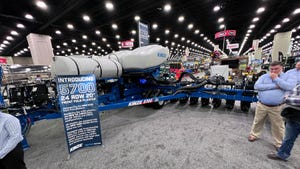
A new 90-ft. White planter with tracks took center stage at AGCO’s largest product launch ever held last summer. The White 8936 large-frame planter has 36 30-in. rows, and is mounted on a 90-ft.-wide frame. Each section of the two-section wings flexes up to 42° on each half of the planter, which allows it to hug field contours. Mounted on top are two 75-bu. seed tanks. Two 750-gal. liquid fertilizer tanks also may be added. The planter is the first in the planter industry to be factory-equipped with tracks. Two 30- x 67-in. rubber tracks carry the planter. Base list price is $262,000.
-
Variable-rate applicator: Raven OmiRow system
Raven solved the technical challenges of variable-rate planting with its new OmniRow planter control system released a year ago. The new system will vary seeding rates as well as automatically turn rows off or on while also providing speed compensation around curves. The heart of the OmniRow system is a hydraulic motor built specially for Raven. The piston motor has internal gear reduction, which allows it to be connected directly to planter hex shafts. Motors are small enough to be mounted to drive a single row, yet will power up to four rows. The motor also serves as a row-unit shutoff. OmniRow is available for most John Deere and Kinze planters. Kits should be available soon for Case IH and White planters. Different levels of control are available, ranging in price from $2,900 for a package to $1,050/row.
-
Seed treatment: Bayer CropScience On-Demand system
The new On-Demand seed treatment system from Bayer CropScience ends the hand mixing that local retailers must do for treating some seed. On-Demand replicates the seed treatment capabilities of large, sophisticated systems used by seed companies but on a small scale for retail outlets. On-Demand is computerized and completely closed with no open chemical containers. Retailers can use the new system to quickly treat seed such as soybeans with inoculants right before delivery to a customer. Because the system is computerized and all recipes for treatments are loaded into the system, error is reduced. Plus, On-Demand has an atomizer for precise application of the treatment.
What do robotic equipment and refuge-in-a-bag corn seed have in common? They are both recipients of the 2012 Farm Industry News FinOvation Award. From the hundreds of new agricultural products that appeared in Farm Industry News or on farmindustrynews.com in 2011, these FinOvation winners were chosen as being the most innovative, based on reader interest. They cover a range of products designed to help corn and soybean farmers make their operations more productive and profitable.
Also, for the first time in FinOvation history, you are invited to select your top products out of all 22 on the farmindustrynews.com home page or by clicking here. Farm Industry News will name a Product of the Year winner based on your votes at the National Farm Machinery Show in Louisville, Feb. 15-18.