Subscribe in NewsGator Online   Subscribe in Bloglines

Cob collection

Jan 1, 2010 12:00 PM, By Lynn Grooms

Equipment manufacturers demonstrate their biomass harvesters at a POET field day

IN FALL 2008, the ethanol company POET held a field day at its plant in Emmetsburg, IA, featuring equipment that could harvest grain as well as cobs in the same field pass. Just two months ago, POET held another field day to show how this equipment has progressed.

Strides made in equipment design are enabling farmers to collect cobs, which POET will use at Project Liberty, the company's 25-million-gallon-per-year cellulosic ethanol facility in Emmetsburg. The biorefinery is expected to begin commercial-scale cellulosic ethanol production by the end of 2011.

Harvesting corncobs is a new revenue opportunity for Emmetsburg-area farmers, says Scott Weishaar, POET's vice president of commercial development. This opportunity could expand to corn growers around the country.

During the field day, POET representatives discussed cob procurement contracts with farmers. These contracts will be for three, four and five years. The contract price for cobs will average $55/dry ton equivalent. A new division, POET Biomass, will manage harvest and transportation logistics for cobs.

Seventeen equipment manufacturers have been working with POET and 14 Emmetsburg-area farmers to test cob collection equipment. They demonstrated their equipment at the field day.

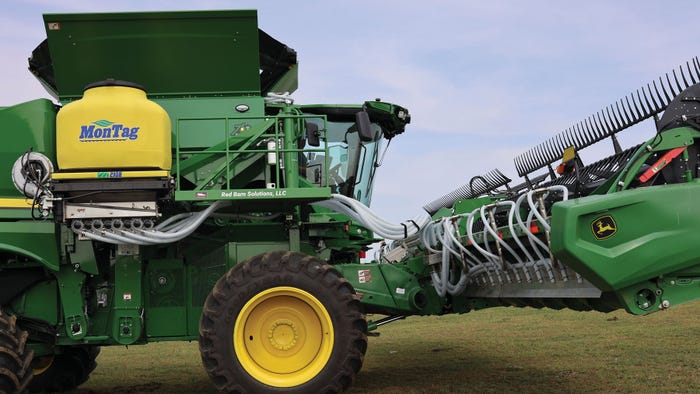
John Deere, for example, demonstrated its corncob biomass harvesting equipment. It has been working on a flexible prototype that will not slow harvest operations.

Case IH showed its Axial-Flow 8120 combine and biomass harvesting equipment. The biomass cart is attached to the combine and works as a system with 88 series and Axial-Flow combines. System controls are integrated into the combine's cab for on-the-go unloading. The cart can be attached and detached from the combine for fast conversion to other crops or harvest modes. It includes an adjustable cleaning system to tailor the cob/stover sample, depending on what the ethanol producer wants.

AGCO featured a one-pass system that combines its combine technology and a Hesston large square baler to collect and package clean corncobs, husks and leaves into 3- × 4-ft. square bales. AGCO expects that the system will be easily adapted to other biomass feedstocks, such as cereal grains, and will be offered for all Class VIII combines.

Also demonstrated was Vermeer's CCX770 cob harvester, a pull-type cob collection wagon that allows farmers to harvest grain and cobs in one pass. This self-contained cob harvester is designed to tow behind qualified corn harvesters.

Redekop Manufacturing showed its C180 cob cart, which holds two loads from the company's H165 cob harvester while on the go in the field. The cart's conveyor unloads cobs from the cart to create tapered piles of cobs. The cart requires only a low-horsepower tractor and is powered by the tractor's PTO and hydraulics.

Also shown was the Oxbo line of high-lift dump carts, which are built to lift and dump up to 30,000 lbs. or 1,100 cu. ft.

Most Recent Story

VIDEOS

PRODUCTS

TECHNOLOGY

FINtv

Farm Industry News TV
Watch video produced by the editors to show the latest equipment from the NFMS and UV Rodeo.

product tests

Product Tests

See the results of the latest farm product tests conducted by Team FIN farmers and magazine editors.

green agriculture

Green Agriculture

Recent articles on Biofuels, Water Quality, Credits, and what "green" practices will impact your business.

Featured FIN Video

BASF Stepping up to the Plate

Get the Flash Player to see this player.

View More FIN tv Videos


Product Info

Visit our online resource to find products and services offered by advertisers featured in Farm Industry News magazine.

More

Continuing Education

Click here for a complete list of Continuing Education Courses


CCA Accredited for 2.0 Units in Nutrient Management:


(New Course)
Utilizing Calcium as Nutrient That Protects Against Disease Organisms

This online accredited course focus on Calcium, an important plant nutrient in fertilizer management for maximum, healthy plant development as well as disease and pest prevention. It is accredited for Certified Crop Adviser credit as well as state hours/credit in California, Georgia, Pennsylvania, West Virginia and New Jersey. Credit pending in Florida, South Carolina, Tennessee, Virginia and Washington.

This course is accredited for CCA Credits:


(New Course)
Spray Drift Management

Keeping crop protection chemicals on the crop for which they are intended has been a cornerstone of farming not only to protect neighboring crops, but to not waste money allowing products to drift off the intended target. This accredited online continuing education course covers the critical elements of spray drift management.

Browse Back Issues

Browse Back Issues